Drywood termite spot treatment provides a non-disruptive alternative to whole-structure fumigation, delivering direct therapeutic control into active colonies while preserving indoor environmental safety. Unlike…
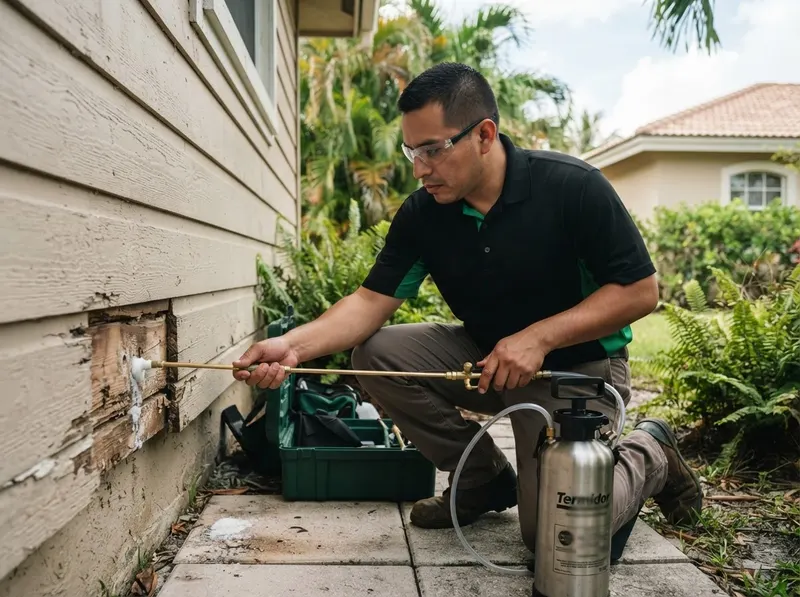
Drywood termite spot treatment provides a non-disruptive alternative to whole-structure fumigation, delivering direct therapeutic control into active colonies while preserving indoor environmental safety. Unlike subterranean species that require soil contact, Cryptotermes brevis (West Indian drywood termite) extracts moisture entirely from wood fibers, establishing self-contained colonies inside fascia boards, attic trusses, and decorative millwork. In historic neighborhoods like El Cid, Flamingo Park, and Grandview Heights, structural framing often consists of dense, old-growth Dade County pine. While naturally rot-resistant, these timbers develop interior stress fractures and carpenter joint gaps where reproductive alates establish nesting sites following spring dispersal swarms. A localized injection treats these isolated galleries directly through millimeter-gauge drill ports, placing the active compound inside the operational core of the colony rather than dispersing aerosols across open living spaces.
Selecting localized remediation over structural fumigation depends on the spatial containment of the colony and surrounding architectural conditions. Whole-house tenting demands multi-day structural evacuations, food containment, and utility disconnections, a difficult undertaking for downtown high-rises or zero-lot-line properties in Riverwalk and Villages of Palm Beach Lakes. Spot remediation permits complete occupancy throughout the application, eliminating lodging displacement and protecting delicate indoor air quality from broad-spectrum gas penetration. The structural trade-off involves gallery accessibility: targeted remediation relies on precise acoustic detection and moisture meters to delineate colony boundaries. If drywood frass drops emerge from more than three distinct, non-contiguous load-bearing elevations, structural fumigation may be required to clear diffuse infestations beyond drill access.
Environmental factors along coastal Palm Beach County influence colony establishment and persistence. In Northwood Village and coastal SoSo (South of Southern), persistent relative humidity exceeding 75% maintains the structural moisture content needed for drywood termites to expand near rooflines and rafter tails. Similarly, properties adjacent to natural preserves, such as the Ibis Golf and Country Club corridor near Grassy Waters Preserve, experience elevated exposure to seasonal swarms originating in native maritime hardwood hammocks. Spot remediation targets these vulnerability zones by coupling non-repellent gallery injections with exterior wood surface sealants, denying external alates entry into raw joinery while arresting active inner damage.
Every job gets a firm, written price after a free on-site visit.
Tell us about your drywood termite spot treatment job in West Palm Beach and we'll send a clear, written quote, usually the same day.
 Iron Gate Pest Control